
Build quality steel structures

Service Hotline:
Welcome to the website of Guangdong Hongzhuo Steel Structure Engineering Co., Ltd.!
Build quality steel structures
Service Hotline:
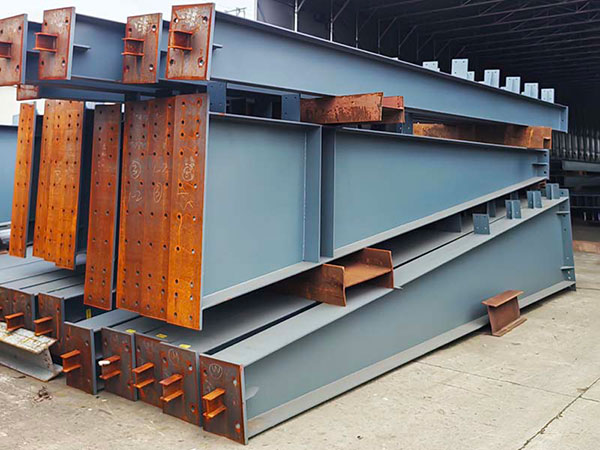
In steel structure factories, warehouses, industrial workshops and large-span steel structures, H-shaped steel is one of the most commonly used main load-bearing components. Depending on different building spans, load conditions and project budgets, H-shaped steel can mainly be in the form of hot-rolled H-shaped steel and welded H-shaped steel.
Many customers will ask when choosing a steel structure factory plan: What are the differences between hot-rolled H-shaped steel and welded H-shaped steel? Which one is safer? Which one uses less steel? In fact, both types of H-shaped steel can be used in steel structure buildings. The key is to choose the appropriate structural form based on the actual project situation.
1. What is hot-rolled H-shaped steel?
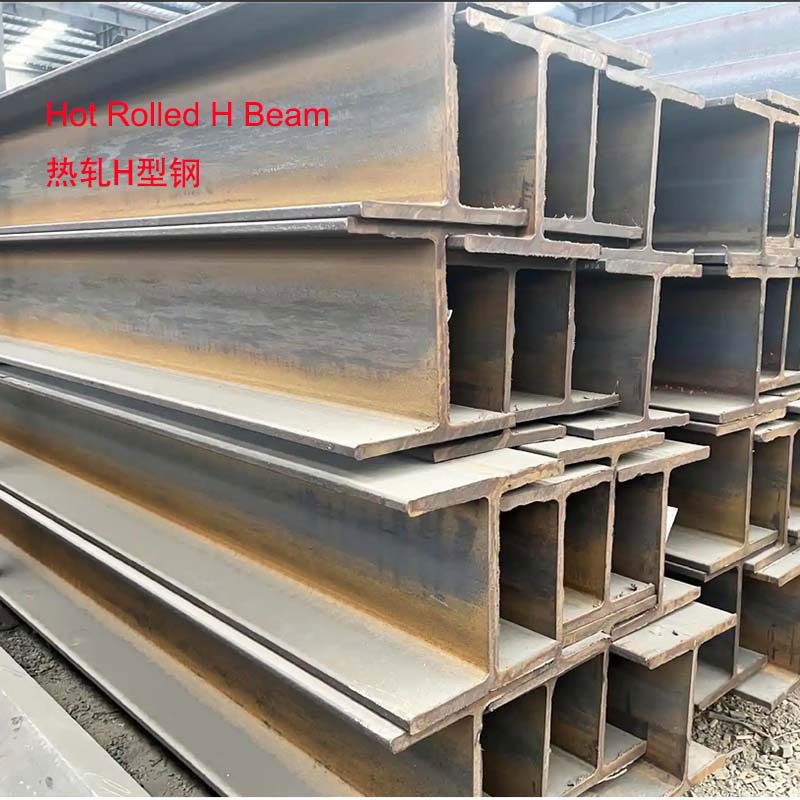
Hot-rolled H-shaped steel is a standard steel section directly produced by steel mills through rolling processes. Its web and flange are rolled as a whole, featuring standardized specifications, stable quality, and low production costs.
The main advantages of hot-rolled H-shaped steel are standardized specifications, convenient procurement, and fewer processing procedures. It is particularly suitable for steel structure factories, warehouses, platforms, and other steel structures with relatively conventional spans and loads.
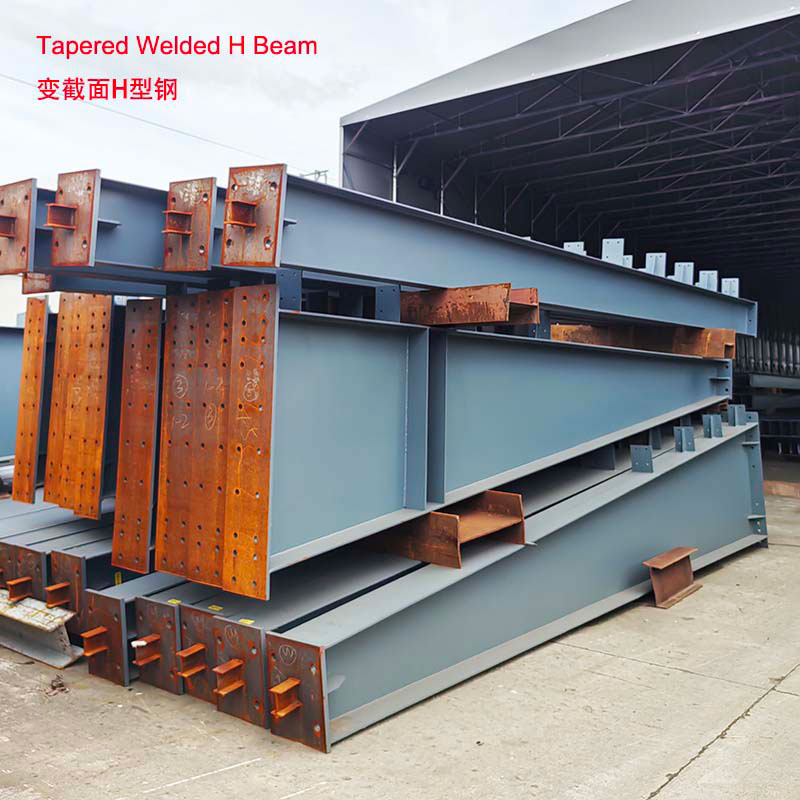
For projects with medium or small spans and relatively simple structural forms, using hot-rolled H-beams can usually reduce the processing workload of steel components and offer better overall economic benefits.
II. What is Welded H-Beam?
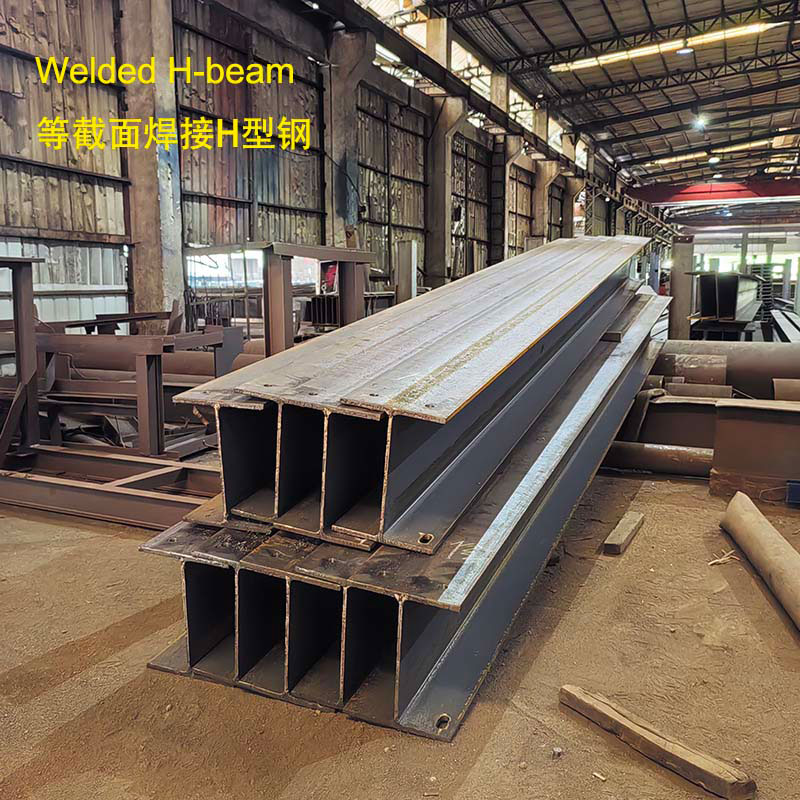
Welded H-beams are manufactured by cutting, assembling, welding, and correcting steel plates. Compared with hot-rolled H-beams, the biggest advantage of welded H-beams is that their cross-sectional dimensions can be customized according to the actual force conditions of the project.
For example, the height of the web plate, the thickness of the web plate, the width and thickness of the flange plate can be adjusted according to the design requirements, thereby obtaining a cross-section that is more suitable for the project.
Therefore, welded H-beams are particularly suitable for large-span steel structure factories, industrial plants, warehouses, and non-standard steel structure projects.
III. What are the differences between hot-rolled H-beams and welded H-beams?
The main difference between the two is not "quality good or bad", but the production method and the flexibility of cross-sectional design.
Hot-rolled H-beams are standardized products, and common specifications can be directly purchased and used; welded H-beams can be customized according to structural design, and are more suitable for optimizing the force conditions at different positions.
In simple terms:
Hot-rolled H-beams: They have a high degree of standardization, making procurement and processing convenient.
Welded H-beams: The cross-section can be customized, making them more suitable for large spans and special structures.
Therefore, it cannot be simply assumed that welded H-beams are always better than hot-rolled H-beams, nor can it be assumed that hot-rolled H-beams are always cheaper. Ultimately, the structure calculation and comprehensive cost comparison based on specific projects are necessary.
Four. Why are welded H-beams often used in large-span steel structure factories?
For large-span steel structure factories, the bending moments borne by beams and columns are usually not uniformly distributed along the entire length of the component.
If the entire component uses the same large cross-section, it may result in excessive steel usage in some areas.
Welded H-beams can be optimized according to the actual stress conditions of the component. For example, using a larger cross-section in areas with higher stress and appropriately reducing the cross-section in areas with lower stress, thereby reducing unnecessary steel usage.
Further using variable-section welded H-beams can enable more steel to be allocated to the required positions, improving steel utilization while meeting the requirements for structural strength and stability.
For large-span portal steel frame factories, this design approach is particularly advantageous.
Five. Are variable-section H-beams necessarily cheaper?
Not necessarily.
Although variable-section welded H-beams have a significant potential for material saving, their processing process is more complex compared to standard hot-rolled H-beams. They require processing such as steel plate cutting, assembly, welding, and correction.
Therefore, in steel structure projects, it is not only necessary to compare "how much does each ton of steel cost", but also to consider:
Steel usage
Steel price
Welding and processing costs
Anti-corrosion and painting costs
Packaging and transportation costs
On-site installation costs
Overall structural performance
The final comparison should be the comprehensive cost of the entire steel structure project.
Six. How should steel structures for factories choose H-beams?
Generally speaking, a preliminary judgment can be made based on project characteristics:
For small and medium-span, standardized factories:
Hot-rolled H-beams can be given priority.
For medium and large spans or non-standard structures:
The comprehensive costs of hot-rolled H-beams and welded H-beams can be compared.
For large-span factories:
Welded H-beams can be given priority, and variable-section welded H-beams can be used for structural optimization when necessary.
For heavy-duty factories, high-rise steel structures, or special buildings:
Professional structural calculations based on actual loads, structural systems, stability, and node designs are required. Selection cannot be based solely on the production form of H-beams.
VII. How do we select the appropriate H-beams for our clients?
Structural steel projects in different countries and regions may vary in terms of wind loads, usage functions, building spans, and construction conditions. Therefore, we do not simply use the same type of H-beams for all clients.
When designing a steel structure factory, we will comprehensively consider factors such as building span, column spacing, eave height, roof and wall materials, wind loads, usage loads, steel grade, transportation conditions, and on-site installation conditions. Through structural calculations, we select the appropriate sections.
For large-span steel structure projects, we can also conduct economic comparisons of hot-rolled H-beams, equal-section welded H-beams, and variable-section welded H-beams, while ensuring safety and design requirements, in order to minimize steel consumption and overall construction costs as much as possible.
Conclusion
Hot-rolled H-beams and welded H-beams do not have absolute superiority or inferiority. Hot-rolled H-beams have the advantages of standardization and convenient processing, while welded H-beams have the advantages of flexible section design and suitability for optimizing large-span structures.
For steel structure factories, the most reasonable choice is not to simply pursue a certain type of H-beam, but to conduct structural design and economic analysis based on the actual situation of the project.
If you plan to build a steel structure factory, steel structure warehouse, large-span industrial building or other steel structure buildings, just provide the building dimensions, span, column spacing, eave height and usage requirements. We can conduct a preliminary scheme analysis based on the project parameters for you and provide corresponding steel structure design and quotation schemes.

Telephone
0769-82669853
13925799110

Mobile Site

Mobile Site